
AI Solutions for Research
Specialised assistants to focus and accelerate your reviews, analyses and reports with methodological rigour.
What does AI Solutions include?
AI Solutions integrates specialised prototype GPTs for the full cycle of academic research: from approach and mapping to systematic review, synthesis and final reporting. These agents align with open science best practices, version control and traceability (PRISMA-S), incorporate quality and bias checklists (JBI, CASP, MMAT, ROBINS-I, AMSTAR-2) and facilitate visualisation (slopegraphs, harvest plots, collaborative networks).
Some important benefits are:
- Verifiable methodological rigour.
- Time savings in screening, extraction and standardisation.
- Transparency: search logs and deduplication.
- Exportable, ready for publication and substantiation.
GPT 01
PRISMA 2020/ScR/SR
Magdiel Torres Vanegas
Oct 2025
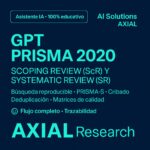
PRISMA GPT automates the systematic review cycle: reproducible search strategy (PRISMA-S), two-stage screening with inter-rater agreement (Cohen’s Kappa), deduplication, standardised extraction, quality matrices (JBI, CASP, MMAT, ROBINS-I, AMSTAR-2) and synthesis (tables and graphs). It generates the PRISMA 2020 diagram and an initial harvest plot to highlight the strength and directionality of findings.
Key features:
- Search logs and reproducibility: terms, filters, databases, dates (PRISMA-S).
- Screening and eligibility: title/abstract and full text with transparent rules.
- Documented deduplication and traceability of decisions.
- Quality and bias: templates by study type (JBI/CASP/MMAT/ROBINS-I/AMSTAR-2).
- Final products: PRISMA 2020 diagram, summary tables, harvest plot.
Use cases:
- Systematic reviews and scoping reviews.
- Evidence mapping reports for public policy.
- Rapid reviews with change logs.
Expected delivery:
- PRISMA 2020 (image and editable source).
- PRISMA-S (search record).
- Extraction and quality matrices (xlsx).
- Summary report with APA 7 (docx).
- Harvest plot and comparative graphs (png/svg).
This assistant automates searching (PRISMA-S), screening, deduplication, and synthesis with quality matrices. It does not invent studies: it provides templates and guidelines; you validate and cite. Keep logs (queries/dates/databases), document inclusion/exclusion, calculate Kappa for inter-rater agreement, and declare the use of AI in your report. Avoid uploading copyrighted text without permission/licence.
GPT 5.0 Thinking
Reference in APA 7a
Estudios Axial Perú EIRL. (2025). PRISMA 2020 (ScR/SR) — GPT PRISMA (v. 1.0, octubre 2025) [Modelo de lenguaje personalizado]. https://chatgpt.com/g/g-68c8f3db6a008191b99dad7f2699f0e6-prisma-2020-scr-sr
GPT 02
MMI (CUAN+CUAL)
Magdiel Torres Vanegas
Oct 2025
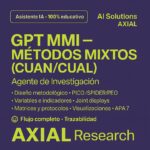
The Research GPT guides you step by step through the design of the study (mixed, quantitative or qualitative), the construction of the theoretical framework, the formulation of RQs, hypotheses and indicators, and produces editable artefacts: PICO/SPIDER/PEO matrices, RACI diagrams for project governance, and tables of operationalised variables. It integrates tips for OSF/Git, version control, and FAIR data.
Key features:
- Assisted methodological design: guide for PICO/SPIDER/PEO, optional PRISMA-S if a review is planned.
- Matrices and templates: extraction, quality, joint displays for mixed studies.
- Writing support: IMRyD sections, APA 7 (citations and references).
- Visualisation: comparative graphs (slopegraphs), networks (collaboration/topics).
- Suggested integrations: C Map, VoS Viewer, OSF, Zotero, Colandr, IRAMUTEQ, Gephi, among others.
Use cases:
- Thesis protocols and original papers.
- Preliminary scoping/rapid evidence assessments.
- Instrument design and analysis plan.
- Executive reports for public decision-making.
Expected deliverables:
- Base document (docx) with IMRyD + APA 7 structure.
- PICO/SPIDER/PEO matrices and variable plan (xlsx).
- Flow guide and quality checklist (pdf).
- OSF/Git model folder (proposed tree).
This tool is for educational purposes. Use it to structure research questions, PICO/SPIDER/PEO matrices, variables, and drafts in APA 7. You must verify all content, cite appropriately, and not reproduce extensive passages that are copyrighted. If you include personal or confidential data, anonymise it and ensure you have CEI/IRB and DMP approval when applicable. Record your sources and methodological decisions.
GPT 5.0 Thinking
Reference in APA 7a
Estudios Axial Perú EIRL. (2025). Agente Métodos Mixtos (MMI: CUAN/CUAL) — GPT de Investigación (v. 1.0, octubre 2025) [Modelo de lenguaje personalizado]. https://chatgpt.com/g/g-68a7760c04d481919d1162bfeb23b448-agente-metodos-mixtos-mmi-cuan-cual
GPT 03
Mapper (CUAN+CUAL)
Magdiel Torres Vanegas
Nov 2025
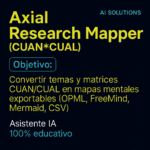
Axial Research Mapper (CUAN/CUAL) guides you step by step to transform themes and operationalisation/categorisation matrices into accurate, exportable mind maps. It rigorously distinguishes between quantitative (variables–indicators–scales) and qualitative (categories–subcategories–codes) components, verifies consistency and depth, and delivers outputs ready for classes, reports, and dashboards. It integrates best practices for term standardisation, version control, and reproducibility (Mermaid/Markdown, OPML/FreeMind, CSV).
Key features
- Guided methodological assistance: CUAN/CUAL structure; suggests indicators/codes when missing (marked with “?”) and validates typing and hierarchy.
- Matrix → Mind map: table (Markdown/CSV), JSON or edges (Parent, Node) ingestion; tag normalisation and deduplication.
- Editable exports: OPML 2.0 (Edraw/EdrawMind), FreeMind (.mm), Mermaid (mindmap) and CSV (nodes/edges) for analysis in Excel/BI.
- Quality and control: CUAN/CUAL coverage report, duplicates, node length (1–5 words) and depth; /simplify and /expand versions.
- Suggested integrations: Edraw/EdrawMind, FreeMind, Markdown/Notion, VS Code (Mermaid), Excel/Power BI for tabular control.
Use cases:
- Design and visualisation of the methodological framework for theses or articles.
- Standardisation of taxonomies (variables and categories, etc.).
- Preparation of classes and posters with consistent mind maps.
- Executive dashboards: CSV export for metrics and indicators.
Expected delivery
- Exportable mind map: OPML 2.0 and FreeMind (.mm) files.
- Mermaid block (for wikis/Markdown) and CSV (nodes/edges) ready for quality control.
- Validation report: CUAN/CUAL coverage, duplicates, depth, and suggestions for improvement.
- Templates for CUAN/CUAL matrices (table/CSV) and Parent,Node example.
Supported input formats:
- Matrix (Markdown/CSV table) with columns: Level, Name, Type (CUAN/CUAL), Definition, Indicators/Dimensions, Instrument/Scale, Source.
- Edges (CSV): Parent, Node for parent→child structures.
- Structured JSON or text (topic/objective/audience).
This tool is for educational purposes. Use it to structure research questions, PICO/SPIDER/PEO matrices, variables, and drafts in APA 7. You must verify all content, cite appropriately, and not reproduce extensive passages that are copyrighted. If you include personal or confidential data, anonymise it and ensure you have CEI/IRB and DMP approval when applicable. Record your sources and methodological decisions.
GPT 5.0 Thinking
Reference in APA 7a
Estudios Axial Perú EIRL. (2025). Axial Research Mapper (CUAN/CUAL) — GPT de Investigación (v. 1.2) [Modelo de lenguaje personalizado]. https://chatgpt.com/g/g-690060bd62b08191a680433f6a22f01e-axial-research-mapper-cuan-cual
Ethics, Authorship and Responsible Use
Educational Purpose
AI Solutions (GPT Research and GPT PRISMA) are academic assistants designed to support-not replace-the researcher’s judgement. The outputs are drafts that require human verification.
Respect for authorship and rights
- GPTs are not a substitute for reading works cited or interpreting them.
- All content used or quoted must be properly attributed (APA 7 or other required style).
- Avoid reproducing lengthy passages from copyrighted works; use short quotations with inverted commas and reference, or faithful paraphrase with appropriate citation.
- If uploading documents, confirm that you have rights or a licence to make them available for educational/academic purposes.
Transparency and traceability
- Records sources, search strings, dates and databases (PRISMA-S).
- Retains logs of screening/deduplication and inclusion/exclusion decisions.
- Declares the use of AI in the methodology/acknowledgements of the manuscript.
Academic integrity
- Do not submit generated text as if it were fully authored by the researcher without review.
- Make your original arguments; use AI to structure, summarise, compare and visualise, not to invent evidence.
- Check all references (DOI, authors, year, pages) before submitting a paper.
Privacy and confidentiality
- Do not upload sensitive personal data or records without anonymisation and, where applicable, ethics approval (IRB/IRB) and data management plan (DMP).
- Use open or permissioned sets for teaching/research; otherwise, use metadata/abstracts instead of full text.
Biases and limitations
- Outputs may reflect corpus/consultation biases. Reviews diversity of sources, time periods and regions.
- Consider quality of evidence (JBI/CASP/MMAT/ROBINS-I/AMSTAR-2) before synthesising.
Disclaimer of Liability
AI Solutions does not provide legal advice. You are responsible for complying with your institution’s policies and applicable copyright and data protection laws.